

Trophy Hunting the Blue Duiker
Blue Duikers are the smallest antelope species that can be hunted in South Africa.
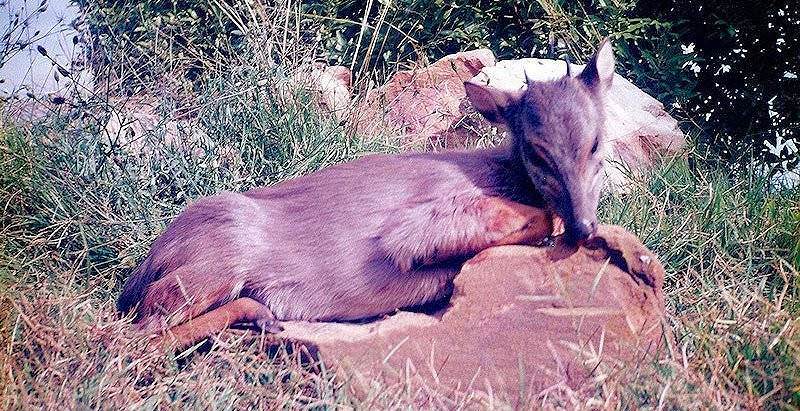


Want a real challenge? Try hunting blue duiker! The blue duiker is the smallest of the duiker species and one of Africa’s smallest antelope species. A member of the duiker family of bovids, he weighs in at only 10 to 12 pounds.
He sports a poorly developed crest of hair between his 2-inch horns, which are often absent in the female (ewe). His hair is a blue-gray with a white belly and a short tail with a white underside. His muzzle is a bit trunk-like and the eyes are placed a bit more forward than those of other small antelope.
Hunting blue duiker can be a difficult endeavor, as this little guy is usually solitary, secretive, silent, and extremely difficult to spot. If caught or startled, they will be heard to make a loud cat-like meow. They confine most of their movements to the dense forest and worn paths between their lying-up, feeding, and drinking places. Being shy and timid, they bolt for cover at the slightest threat of danger.
Hunting blue duiker is often best done using a shotgun. While any caliber rifle would certainly be adequate, the hunter can only expect to get a fleeting glance of this tiny antelope, which would make a rifle shot extremely difficult. Classic shot placement of course would be on or just behind the shoulder, however, when hunting blue duiker, one may have to settle for a hit wherever it can be made.
Our Favorite Area in South Africa for a Blue Duiker Hunt
Blue duiker occur in dense coastal and scarp forests and thick riverine vegetation along South Africa’s eastern seaboard. In practice, this means they are most often pursued in suitable Eastern Cape concessions where evergreen thicket and forest patches provide the cover and travel routes these tiny antelope rely on.