

Hunting Namibia
The vast, open spaces of Namibia offer exceptional hunting safaris in a variety of wilderness areas.
Fair-Chase Safaris in the Vast, Wilderness of Namibia
Namibia lies on the west coast of Southern Africa. It borders Angola to the north, Botswana to the east, and South Africa to the south. A narrow panhandle extends from the country’s northeast corner, known as the Caprivi Strip (now officially called the Zambezi Region), which reaches toward both Zambia and Zimbabwe. Namibia safaris are arranged on special request only and should be booked at least 12 months in advance to ensure availability, permits, and proper logistical planning.
The cold Benguela current of the Atlantic Ocean keeps the coastal areas of Namibia cool, damp, and rain-free, with thick coastal fog often prevalent. Inland, rain falls during the summer months between October and April, with days being hot while nights are cool. Namibia covers an area of some 825,000 square kilometers and is sparsely populated with only about 3.1 million (2025) inhabitants. English is the national language, however, Afrikaans is widely spoken with German and Bantu occurring in some areas.
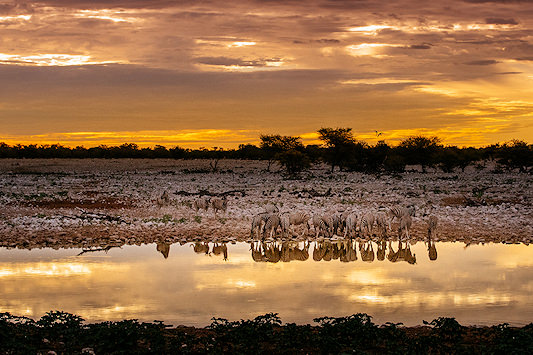
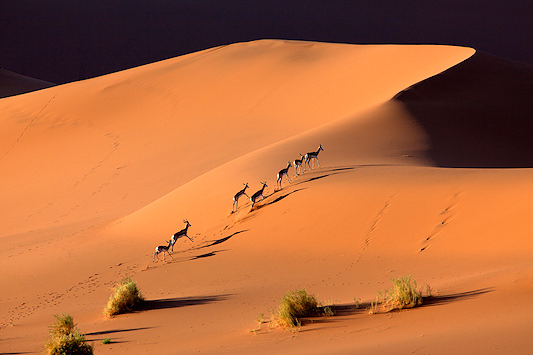
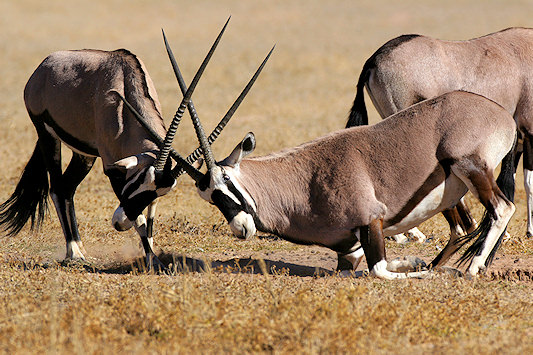
Namibia is known for its rich and diverse wildlife resources and, over the past several decades, has been a prime destination for sport hunters from all over the globe. Conservation programs have largely protected this important resource and species such as kudu, gemsbok, springbok and even warthog are found in abundance. With the government's positive attitude toward sport and trophy hunting, outfitters from all over Southern Africa visit to take advantage of Namibia's great hunting opportunities. The hunting industry has proven itself crucial to ensuring the survival of Namibia's game species.
Among the species indigenous to Namibia are the typical plains dwellers, such as the springbok, blue wildebeest, and the African elephant. Namibia sports the largest population of black rhino in all of Africa. The roan antelope is making a recovery and several antelope species such as the red lechwe, waterbuck, reedbuck and the sitatunga can be found in the wetlands of the far northeast.
Namibia Hunting FAQ's
Prepare for your Namibian safari with essential travel information. Our FAQ covers international arrivals into Windhoek, the benefits of hunting the May-to-October dry season, and exciting sightseeing opportunities for non-hunters at world-renowned destinations like Etosha National Park and Sossusvlei.
Most hunting safaris in Namibia start with an international arrival into Windhoek (Hosea Kutako International Airport). Some guests connect via Johannesburg or Cape Town. Your PH team will meet you on arrival and transfer you to camp by road, with driving time depending on the concession. If your flight lands late, an overnight stay in Windhoek is recommended.
Namibia is best hunted during the dry season from May to October. During this period, days are mild and nights can be cold. Visibility improves as vegetation thins and animals concentrate around water sources. While summer hunting (November to April) is possible, it brings higher heat and denser green cover.
Non-hunters can enjoy world-class sightseeing, including photographic trips to Etosha National Park and the scenic desert landscapes of Sossusvlei. Coastal excursions for beach walks and local dining can also be arranged. At camp, guests often enjoy birding, nature walks, and swimming between shared meals.
Namibia's terrain is defined by wide-open spaces, arid savannas, rocky hills, and dry riverbeds. Vegetation is typically sparse, making it ideal for rewarding spot-and-stalk hunting. Conditions range from desert-edge plains to the lush wetlands of the Zambezi Region in the far northeast.